
The Most Advanced Online Marketing Assessment You Can Do, and How It Works
A full walk-through of the GoGee.ai Insights assessment: every advertising, analytics, search, lead, store and competitor source assessed together on your own live accounts, read-only, and explained to you on a call.
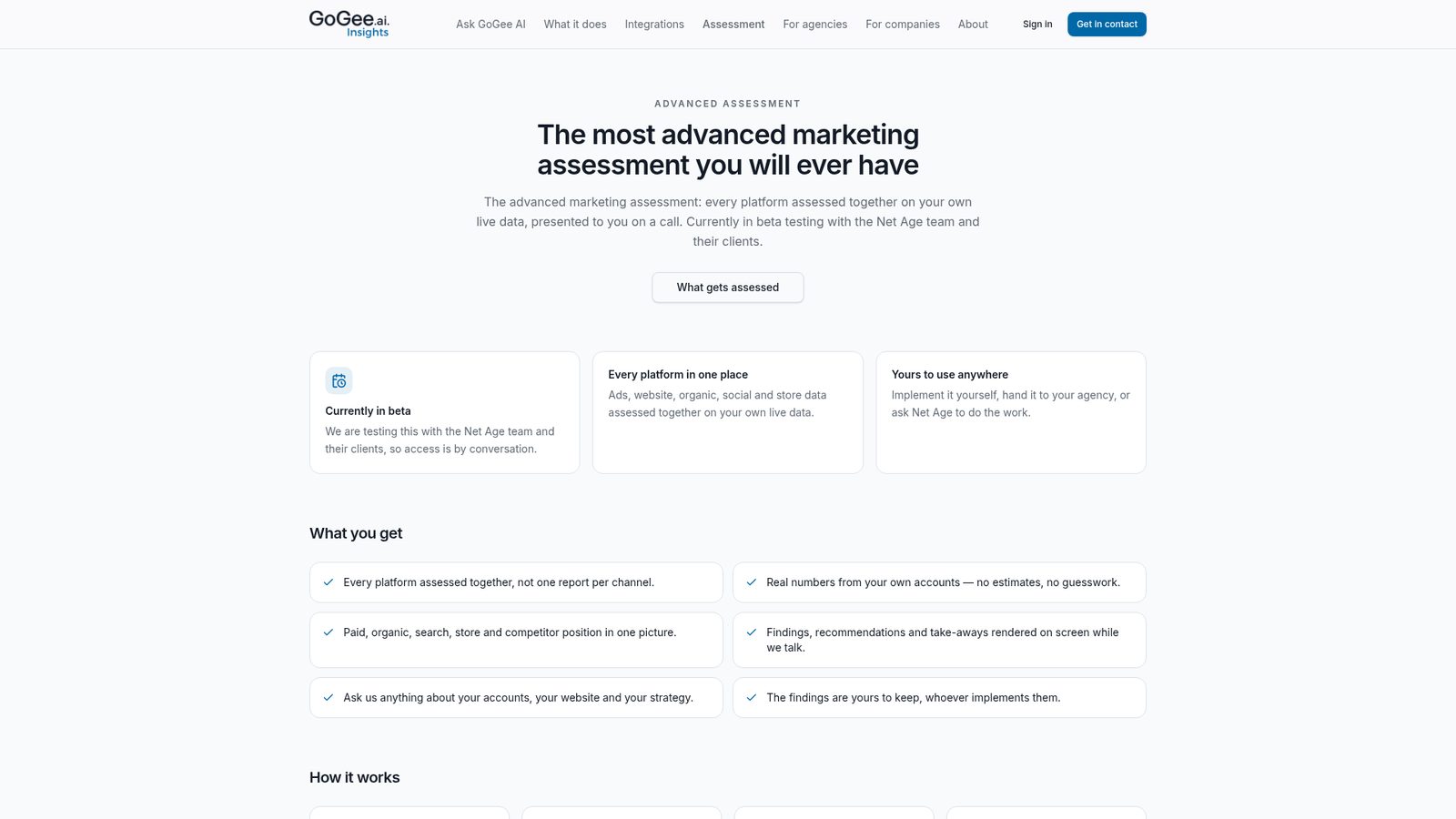
Most businesses do not have a reporting problem. They have a joining-up problem. Google Ads has its own numbers. Meta has its own numbers. Analytics tells a third story, Search Console a fourth, and the till or the online store quietly holds the only figures that actually pay salaries. Every one of those reports is accurate. Put together, they still do not answer the question that matters: what should we change on Monday?
That gap is why we built the GoGee.ai Insights assessment. It is an advanced online marketing assessment that looks at every platform you run, at the same time, on your own live accounts, and then hands the findings to you in a conversation instead of a PDF. This article explains what it is, what it looks at, how the session runs, and how to read your own findings once you have them.
One thing to say up front, because we would rather tell you than oversell it: the system is currently in beta testing with the Net Age team and their own clients. Access is by conversation, not by signing up on a form. Some connections are live today, a few are still being completed, and we label which is which honestly.
Why the usual reporting quietly fails you
There are three failures that repeat in almost every account we look at, and none of them are anyone being lazy.
One report per channel
The person managing search sees search. The person buying Meta sees Meta. Nobody sees the sentence that only appears when you put them side by side, for example that the product selling fastest in store has no advertising behind it at all, or that the campaign with the best cost per lead is the one being starved of budget.
Numbers that are already old
Monthly reporting is a snapshot of a month that has already been paid for. By the time a wasted spend pattern reaches a slide, it has been running for six weeks. Money that has already left the account cannot be moved.
No answer to the only real question
A report says what happened. It rarely says what to do, in which order, and what it is worth. That last part is judgement, and judgement needs every number in front of it at once.
What the assessment actually is
The assessment is a guided review of your marketing where every source is read together, live, while you watch. It is not an audit template with your logo on the front. Nothing is estimated, because the figures come from your own accounts at the moment they are asked for.
Three things define it:
- Every platform in one picture. Paid, organic, search, leads, store and competitor position, assessed together instead of one report per channel.
- Real numbers from your own accounts. No benchmarks, no industry averages standing in for facts you already own.
- Yours to use anywhere. The findings belong to you. Implement them yourself, hand them to your existing agency, or ask Net Age to do the work. That choice stays yours and it does not change what we tell you.
Read-only, always, and why that matters
Every connection is read-only. The system looks at your accounts to report on them, and it never pauses a campaign, changes a budget, edits an ad or touches a product. Anything that would change your advertising stays a decision you make, inside the platform that owns it.
That is not only a safety promise, it also removes the reason most businesses hesitate. You are giving view access to accounts you already own, for a review you already wanted, and nothing is copied into somebody else nightly warehouse to go stale. The reading happens when the question is asked.
Ask GoGee AI: the front door
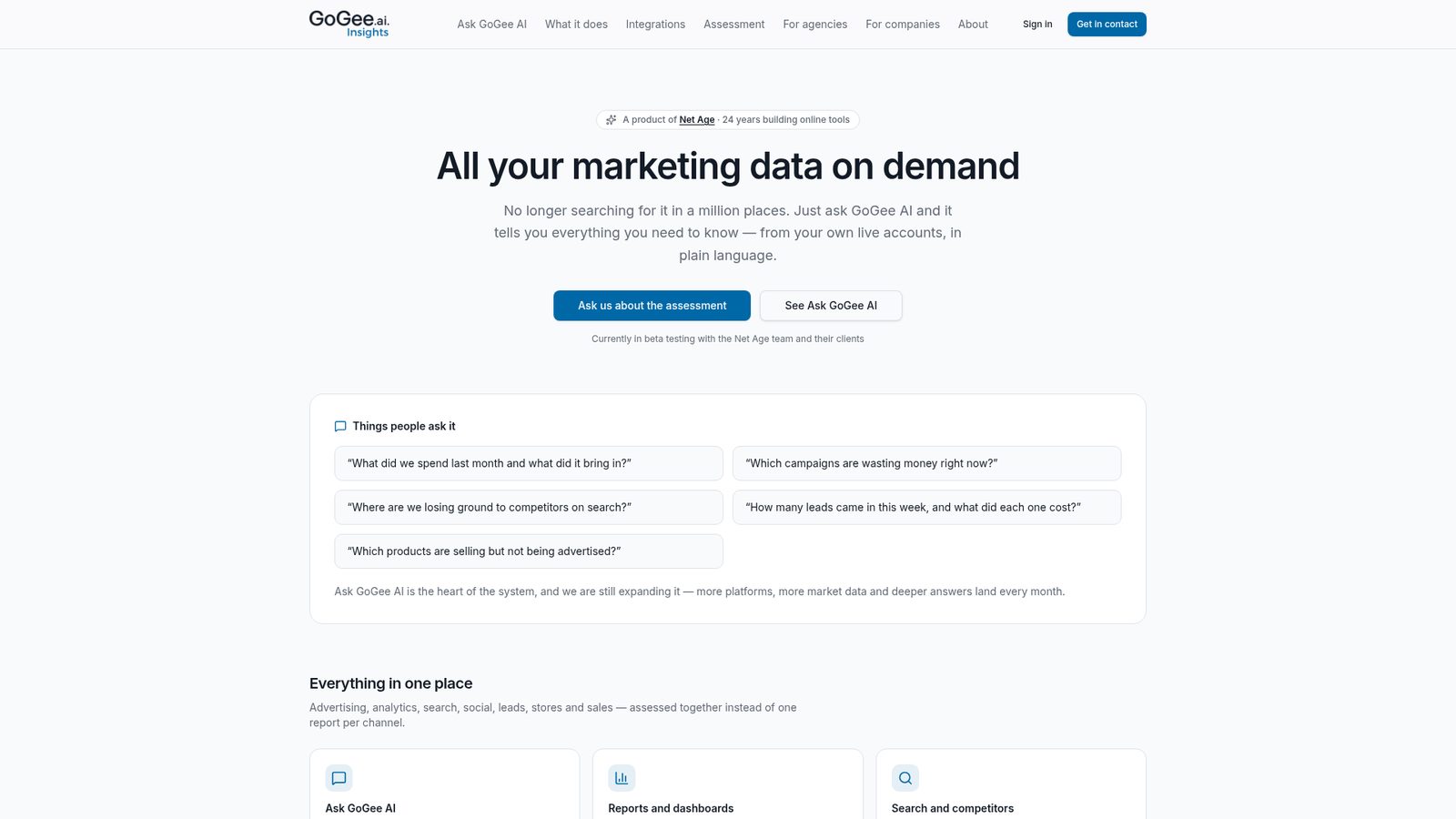
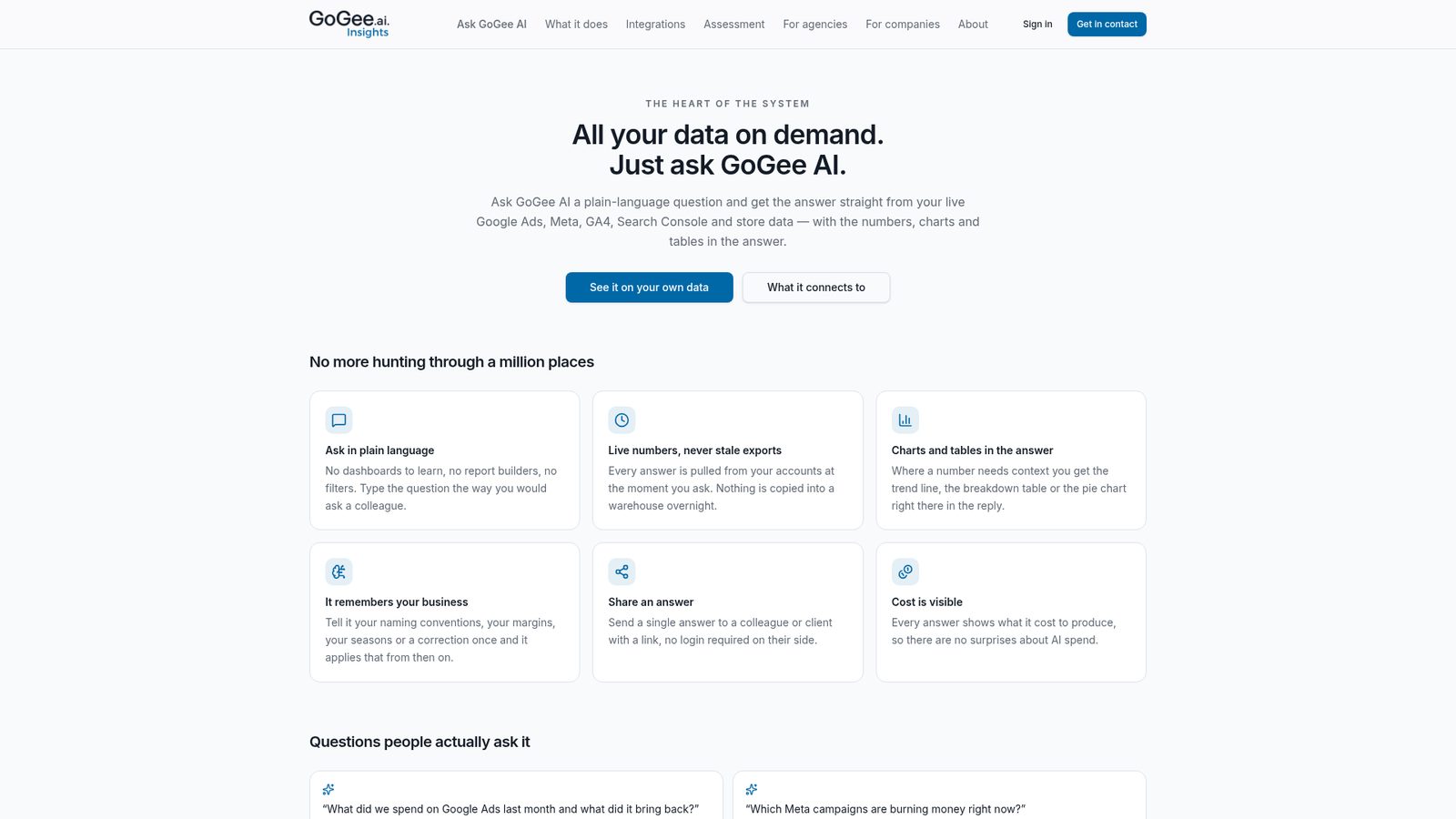
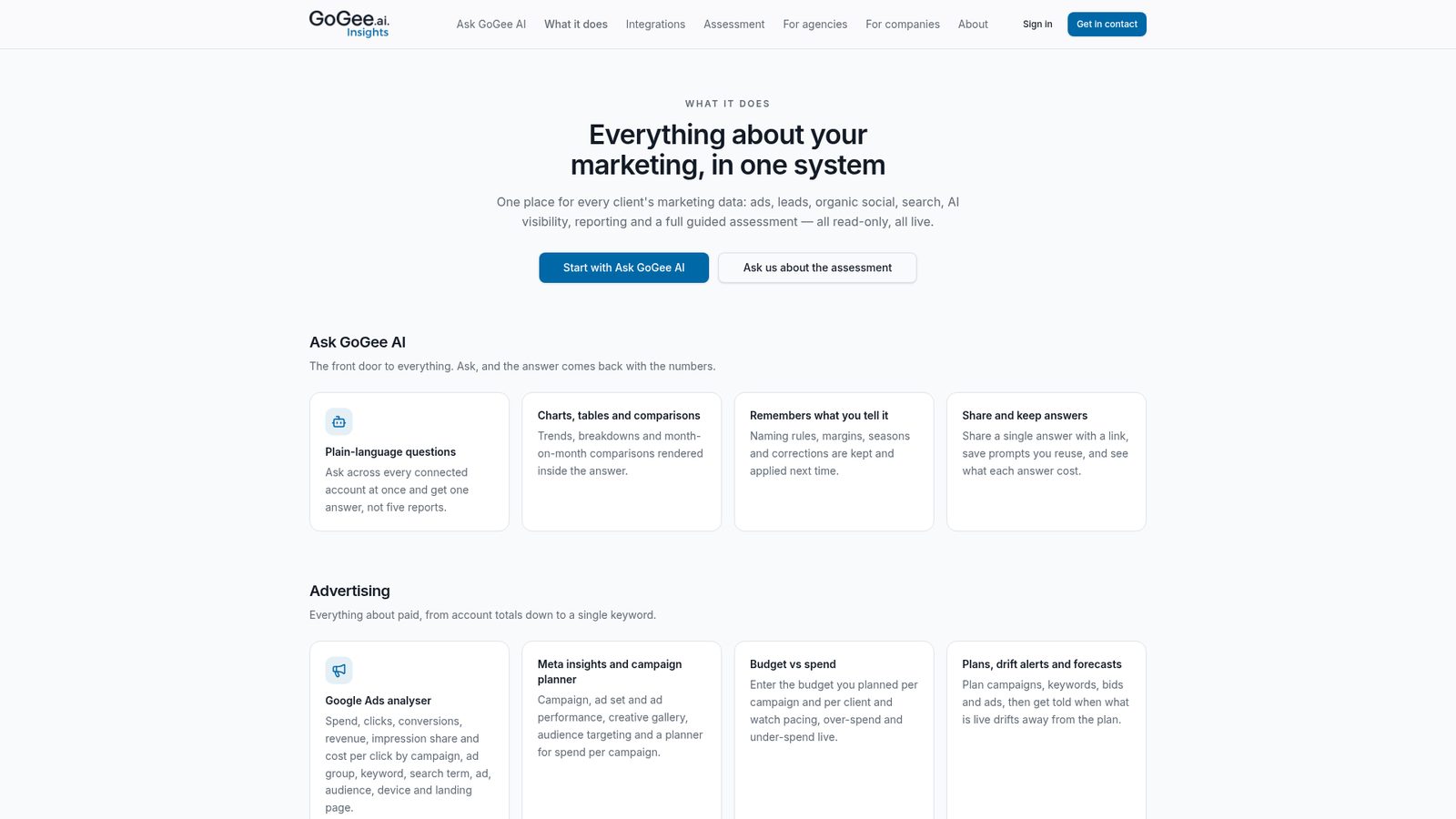
The part people remember is the asking. Instead of learning a dashboard, you type the question the way you would ask a colleague, and the answer comes back with the figures behind it.
Real examples of what gets asked during a session:
- What did we spend on Google Ads last month and what did it bring back?
- Which Meta campaigns are burning money right now?
- Show me my top ten landing pages by revenue this quarter.
- How many leads came in this month and what did each one cost?
- Which keywords did we lose position on in the last thirty days?
- Which products are selling but not being advertised?
Where a number needs context, the answer includes the trend line, the breakdown table or the comparison, inside the reply rather than in an attachment. If you correct it once, or tell it your naming rules, your margins or your seasons, it keeps that and applies it from then on. Individual answers can be shared with a colleague or client by link, and every answer shows what it cost to produce, so there are no surprises about AI spend.
What gets assessed
This is the part worth reading slowly, because it is the difference between a website review and an assessment of a business.
Advertising, down to a single keyword
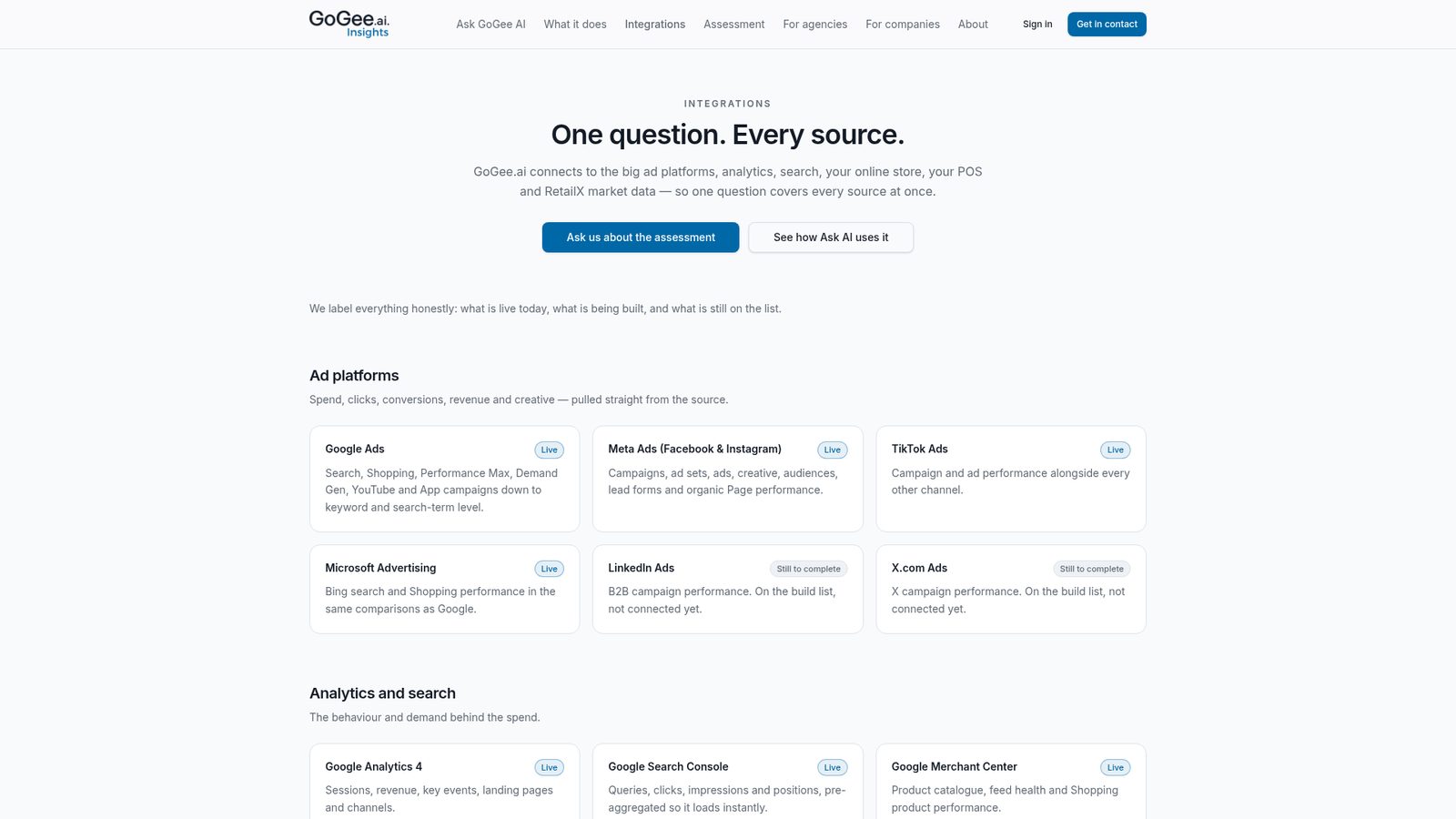
Google Ads is read all the way down: spend, clicks, conversions, revenue, impression share and cost per click, by campaign, ad group, keyword, search term, ad, audience, device and landing page. Search terms matter more than people expect, because that is where you find the money spent on searches you would never have chosen to pay for.
On Meta the same depth applies to campaigns, ad sets and ads, with the creative itself and the audience targeting in view. Two further pieces usually change the conversation: budget against actual spend, so pacing, over-spend and under-spend are visible per campaign and per client, and drift, where what is live is compared to what was planned so you are told when the two have parted ways.
Leads, not conversion counts
A conversion count tells you a form was filled in. The assessment looks at the actual submissions: the name, the email, the phone number and the answers, with the campaign, ad set and ad that produced each one. Then it looks at what happened next, because a lead has an owner, notes, a next step and a due date, and overdue follow-ups are visible.
This is where the most expensive problem in South African marketing usually hides. Not the ad spend, the leads that were paid for and never phoned back. Once cost per lead is calculated on real submissions rather than on tracked events, the number of leads that went nowhere becomes impossible to look away from.
Organic and social
Follower growth, reach, engagement and top performing posts, with history kept so the pattern is visible rather than only the last thirty days. Organic sits next to paid on purpose. Often the best performing organic post is telling you what the ads should be saying.
Search, demand and competitors
Search Console queries, clicks, impressions and positions, plus keyword demand, rank tracking over time, and live search results showing where you sit against your competitors. Competitor ad copy, Shopping prices and estimated ad presence are tracked too, which answers a question no internal report can: not how you did, but how you did compared with the people bidding against you.
A technical site audit runs alongside this, including page speed. If you want the plain-language version of why speed matters commercially, we wrote about it separately in Largest Contentful Paint and what slow pages cost you.
AI visibility
Buyers increasingly ask an AI assistant before they open a search engine. The assessment tracks a set of prompts relevant to your category and checks whether your brand is named in the answer, and how often, against the competitors that keep appearing. That is your share of voice in a channel that did not exist a few years ago and that nobody has a monthly report for yet.
Stores, feeds and the till
Products, stock, combos, feed health and sales sit next to the advertising that drove them. GoGee Commerce is connected, Shopify, PrestaShop and WooCommerce connections are in progress, and if a point of sale system can export or expose its sales, in-store sales can be brought in so they sit beside online spend. Marketing decisions made without stock and margin in view are guesses with a budget attached.
Reporting and the client portal
Beyond the assessment itself there are live dashboards, stored monthly reports, scheduled reports and alerts, and a portal where a client can look at their own numbers without asking anyone for an export. The assessment is the first conversation. The reporting is what stops the next twelve months being a series of surprises.
How the session runs, step by step
- You send your details. Company, website and the platforms you run. That is enough to prepare.
- You give read-only access. View level access to the accounts you already own. Nothing is imported, copied or changed.
- A person comes back to you. Someone from the Net Age team confirms what was connected and arranges a time. It is a conversation with a human, not an automated report send.
- The findings render on screen while we talk. Questions are asked live, the answers appear with the numbers, and anything you want dug into gets dug into there and then. You leave with the findings, the recommendations and the take-aways.
The session usually runs about an hour, and the first fifteen minutes on live data tend to be more useful than a month of reports, because you can interrupt. A report cannot be interrupted, which is exactly why it so often answers the wrong question beautifully.
How to read your own findings
When the findings land, work through them in this order. It is the order of how quickly money moves.
- Waste first. Search terms you never wanted to pay for, campaigns spending with no return, ad sets running against the wrong audience. This is the fastest money in the building, because stopping something takes no creative work.
- Leads never followed up. Count them, then multiply by your average order value and close rate. That figure is almost always larger than the wasted ad spend and almost always cheaper to fix.
- Pacing and budget. What was planned, what is actually being spent, and where a good campaign is being starved while a poor one runs full.
- Demand you are not covering. Keywords with real volume where you do not appear, and products selling without support.
- Position against competitors. Where you have slipped, who took the position, and what they are saying and charging.
- Technical and speed issues. Slower to fix, but they quietly reduce the return on everything above.
Good questions to ask in the session: what is the single largest amount of money being wasted right now, what would you fix first if it were your business, which one change has the best return for the least work, and what will this look like in ninety days if we change nothing.
What it costs to keep guessing
Three costs repeat, and none of them appear on an invoice. Advertising spend against searches, audiences or products that were never going to buy. Leads that were paid for, arrived, and were never contacted. Search positions given up slowly to a competitor who simply kept publishing while everyone else reported.
None of those are visible in a channel report. All three are visible within an hour when every source is read together.
Questions we get asked before people say yes
Do I have to change agencies?
No. The findings are yours regardless of who implements them. Plenty of assessments end with a client handing the list to the agency they already use, and that is a perfectly good outcome. We would rather be useful than territorial.
Is it safe to give access to my accounts?
You give view level access only, to accounts that stay in your name. Nothing is imported into another system, nothing is copied overnight, and nothing can be changed from our side. Access can be removed by you at any time, in the platform itself, without asking us.
What if my tracking is a mess?
Then that is the first finding, and it is a useful one. Almost every account we look at has at least one measurement problem: duplicated conversions, a form that reports twice, revenue passing through untagged, or a thank you page counted as a sale. Knowing which numbers you cannot trust is more valuable than adding another report on top of them.
Do I need to be spending a lot for this to be worth it?
No. Smaller budgets often show the largest percentage of waste, because there is less room to absorb a campaign that is not working. What matters is that there is real activity to read: some advertising, a website with traffic, and enquiries or sales arriving.
What if some of my platforms are not connected yet?
We assess what is connected and say plainly what is missing. The integrations list is kept honest about what is live, what is in progress and what is still on the build list, so you always know whether a gap is your setup or ours.
How often should this be done?
Once properly, then continuously. The assessment is the deep look. After it, dashboards, stored monthly reports and alerts keep the same view in front of you, so the next problem surfaces in days rather than in the next quarterly review.
What do I actually walk away with?
A clear list of what is being wasted, what is being missed, where you stand against competitors, and what to do in which order. Plus the numbers behind each point, so nobody has to take our word for it.
How to get one
The assessment is in beta with the Net Age team and their clients, so access happens by conversation. Send your details on the GoGee.ai assessment page, or if you would rather start with us directly, use the Net Age contact page or have a look at our other free marketing tools first.
Whatever you decide to do with the findings, you keep them. That is the part we care about most. A business that can see all of its marketing in one picture makes better decisions, whoever ends up doing the implementation.